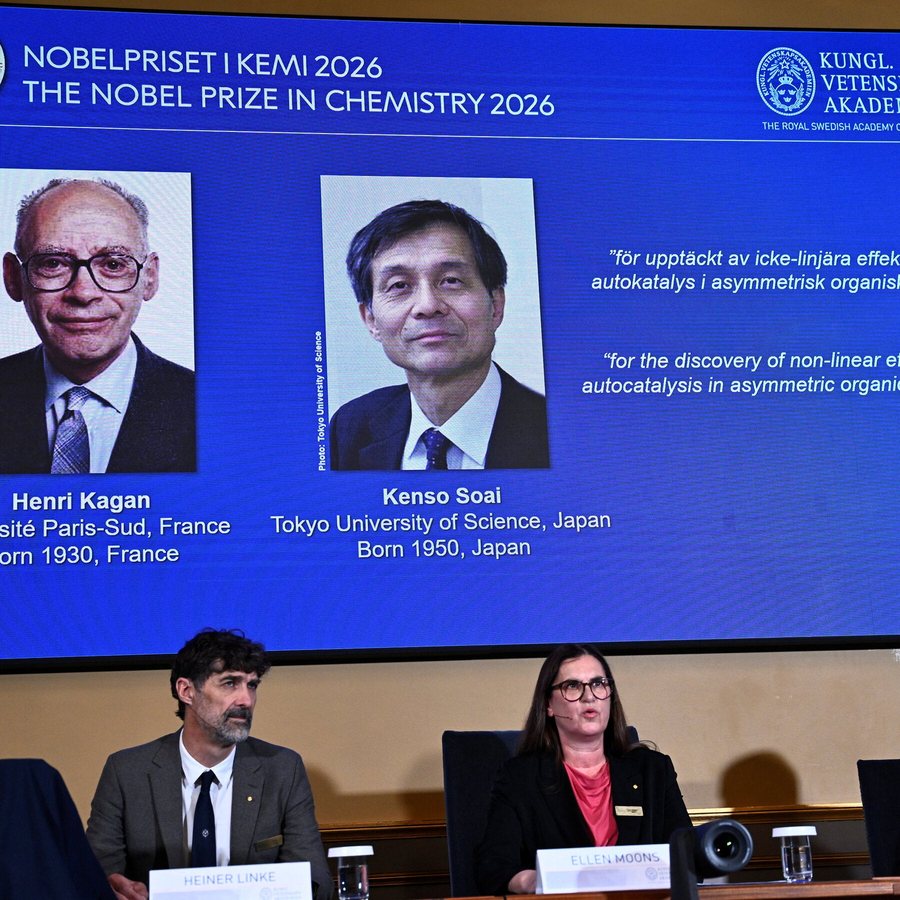
Henri Kagan and Kenso Soai have been awarded the 2026 Nobel Prize in Chemistry, the Royal Swedish Academy of Sciences announced at a news conference in Stockholm on Wednesday.
The two researchers were recognised for their contributions to asymmetric catalysis, a branch of chemistry that allows scientists to build molecules in a single, chosen mirror-image form rather than as a mixture of both. That control matters enormously in medicine, where the two mirror forms of the same molecule can behave very differently in the body — one may be an effective drug while the other is inactive or harmful.
Kagan, a French chemist, is widely credited with pioneering practical methods for asymmetric catalysis in the 1970s and 1980s, work that helped transform how pharmaceutical and fine-chemical companies design and manufacture complex compounds. His methods gave chemists a reliable toolkit for steering reactions toward one specific mirror form, a capability that had previously been difficult and expensive to achieve.
Soai, a Japanese chemist, is best known for a discovery that reaches beyond industrial chemistry into one of the deepest puzzles in science: why life on Earth uses only one mirror form of the molecules that make up proteins and genetic material. His work demonstrated that a reaction can amplify a tiny initial imbalance in handedness into a strong preference for one form, a process known as asymmetric autocatalysis. That finding offered a plausible chemical explanation for how nature's one-sidedness might have arisen.
The prize recognises decades of patient laboratory work rather than a single breakthrough. Asymmetric catalysis now underpins the production of many medicines, including antibiotics and treatments for heart disease and Parkinson's disease, and has become a standard part of the training of chemists worldwide.
Announcing the award in Stockholm, the Academy cited the laureates' role in giving chemists precise control over molecular shape. The prize is one of the most closely watched in science and is traditionally announced in early October.
For the Caribbean, the award carries a quieter significance. Chemistry graduates from the region who go on to research careers abroad often work in fields shaped by the methods Kagan and Soai developed, and the principles of asymmetric synthesis are taught in university laboratories across the islands. The recognition of work that took years to mature is also a reminder that scientific progress is rarely sudden.
Kagan and Soai will share the prize, with the formal award ceremony to be held in Stockholm on 10 December, the anniversary of the death of Alfred Nobel. The Academy did not immediately release further details of the citation or the division of the prize money.
2