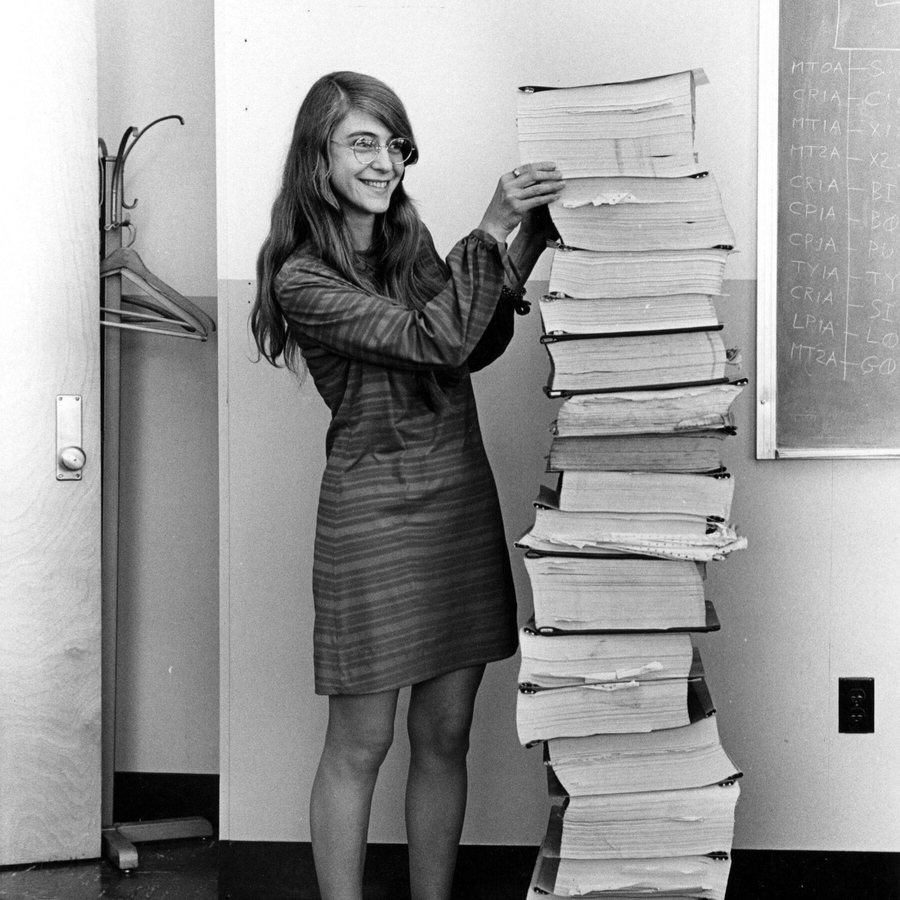
Margaret Hamilton, the computer scientist whose flight software guided the Apollo missions to the Moon, has died. She was widely credited with helping make the first crewed lunar landing possible and with establishing software engineering as a recognised discipline.
Hamilton led the team at the Massachusetts Institute of Technology Instrumentation Laboratory that developed the onboard flight software for the Apollo Guidance Computer. The software had to work in real time, with limited memory and processing power, aboard a spacecraft travelling to the Moon and back. It was designed to detect and recover from errors, a priority that proved decisive during the Apollo 11 descent in July 1969.
During that landing, the guidance computer was overloaded by radar data. The software, built with error-detection and priority scheduling, shed lower-priority tasks and kept the critical descent calculations running. The landing succeeded. Hamilton's approach — designing software that could identify and manage its own faults — became a foundation of modern computing practice.
She is also credited with popularising the term «software engineering» at a time when programming was often treated as an adjunct to hardware development. Her work helped establish that software deserved the same rigour, planning and testing as physical engineering.
Hamilton was born in 1936 in Paoli, Indiana. She studied mathematics at Earlham College and later worked at MIT, where she joined the Apollo effort. She went on to found Hamilton Technologies, developing the Universal Systems Language and related methods for reliable software design.
Her contributions received renewed public attention in later years. In 2016, she was awarded the Presidential Medal of Freedom, the highest civilian honour in the United States, for her work on Apollo and her broader impact on software engineering. Her name and image became familiar to a new generation through accounts of the Apollo programme and the history of computing.
For Dominicans and others across the Caribbean, Hamilton's story carries particular resonance. It is a reminder that small teams, working with limited resources, can achieve results of global significance. Her discipline — anticipating failure, building safeguards, and testing under pressure — mirrors the preparedness culture that the Office of Disaster Management and the Dominica Meteorological Service promote each hurricane season.
Her death was confirmed in the United States. Tributes have focused on the quiet, exacting work that made the Moon landing possible and on the standards she set for software that people depend on. Engineers and scientists across the world continue to build on the principles she championed.
Hamilton's legacy extends beyond Apollo. The methods she developed for error detection, priority management and systems reliability are embedded in the software that runs aircraft, medical devices, communications networks and spacecraft today. In an era when Caribbean economies are expanding digital services, her example underscores the value of rigorous engineering and the importance of training in science, technology, engineering and mathematics.
She is survived by her family and by a profession that owes much of its identity to her insistence that software be treated as a serious engineering discipline. Her work remains a benchmark for reliability in systems where failure is not an option.
4