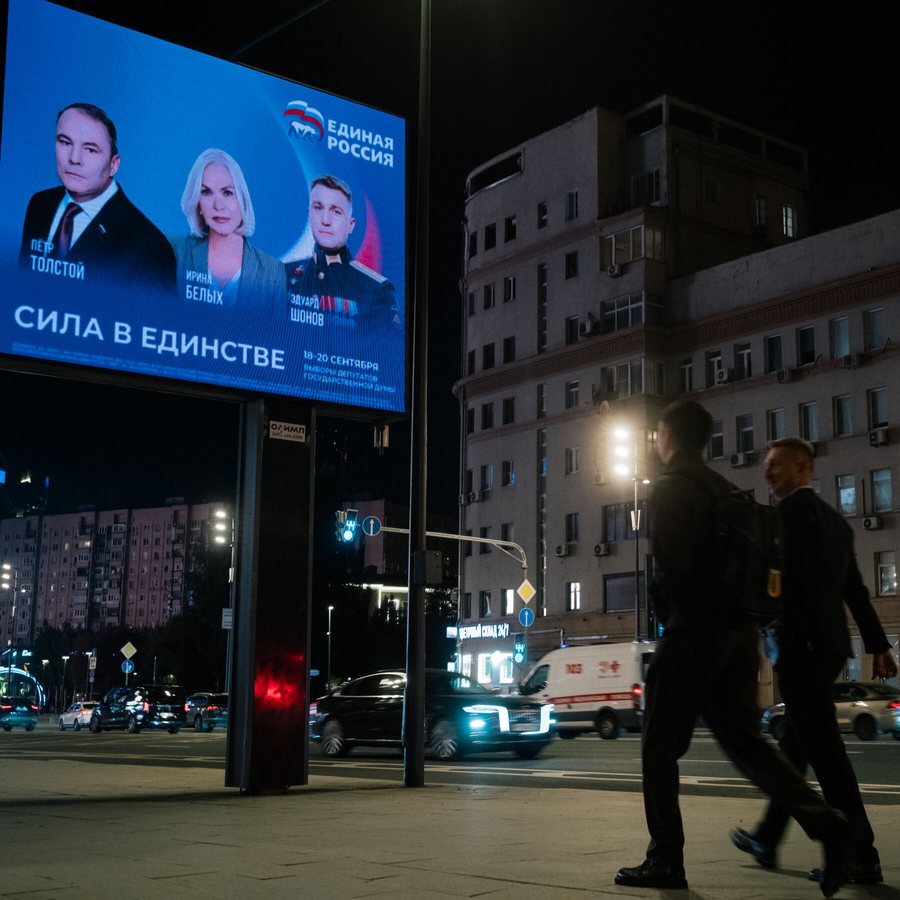
Russia has held a round of elections that observers and critics describe as stage-managed, with the pro-Kremlin United Russia party positioned to dominate the outcome and genuine political competition effectively absent from the ballot.
Campaigning was carried out under conditions that leave little room for opposition challenge. Advertising for United Russia candidates was visible in Moscow and other cities, while independent and opposition voices faced restrictions that have tightened over successive electoral cycles.
The result is an electoral exercise in which the main question is not who will win but by what margin the governing party and its allies will be returned. Such votes are used by the authorities to demonstrate public endorsement rather than to test it.
For the Kremlin, the value of the exercise lies in the appearance of legitimacy it confers. A predictable result allows the government to present its programme as backed by the electorate, even as the space for dissent narrows.
The pattern is familiar from previous Russian elections, in which administrative pressure, control of broadcast media and the exclusion of credible challengers combined to produce outcomes that were never seriously in doubt. Each cycle has reinforced the same structure.
International observers have in past elections declined to describe Russian votes as free and fair, citing the absence of a level playing field. The latest round appears to follow that established pattern rather than depart from it.
For Dominica and the wider Caribbean, the developments carry no direct consequence, but they add to a global picture in which the conduct of elections is increasingly contested. Small states that depend on predictable international rules have an interest in how major powers manage their own democratic processes.
The elections are expected to confirm the governing party's dominance and to leave the political landscape largely unchanged. No significant shift in Russia's domestic direction is anticipated as a result of the vote.