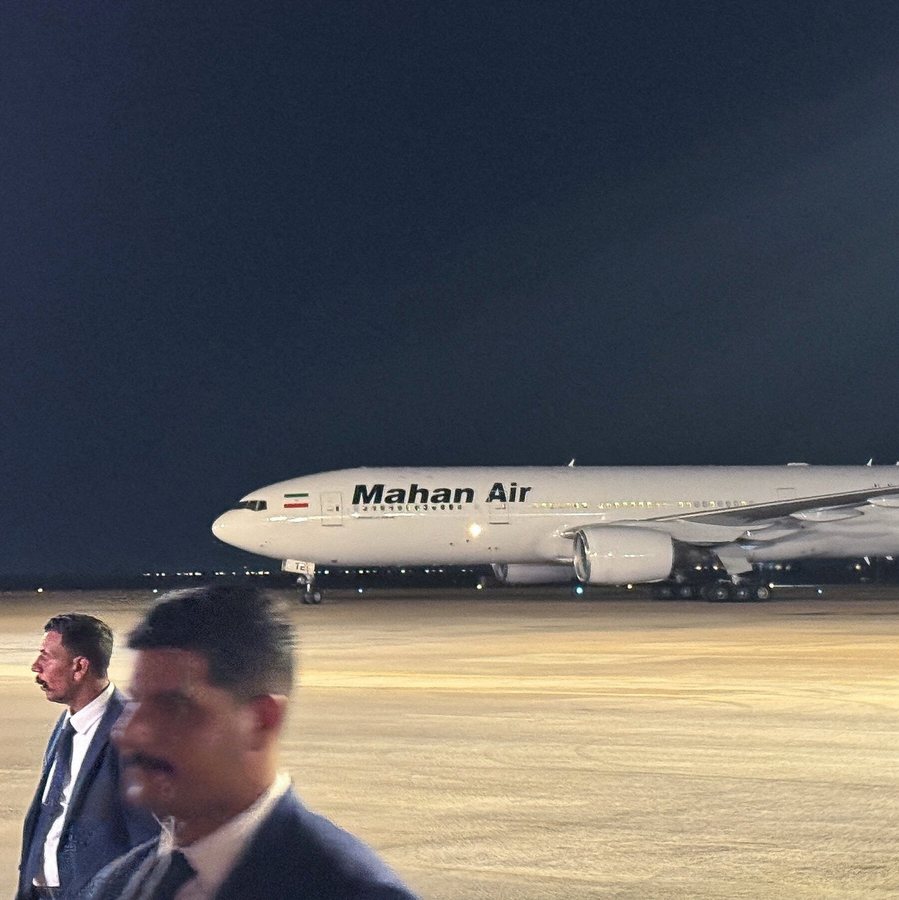
A Boeing 777 operated by Iran's Mahan Air is still flying commercial routes despite a United States sanctions campaign intended to ground the country's aviation sector, according to flight tracking data and airport officials. The aircraft, registered with the tail number EP-MTE, arrived at Najaf International Airport in Iraq in July carrying the casket of Iran's supreme leader, Ayatollah Ali Khamenei, who was killed in US-Israeli strikes in February.
The flight underscores the difficulty Washington faces in fully enforcing aviation sanctions against Tehran. Mahan Air has long been designated by the US Treasury for allegedly providing material support to Iran's Islamic Revolutionary Guard Corps, yet the airline continues to operate a fleet that includes long-range Boeing aircraft acquired before sanctions were tightened. The 777's journey to Najaf, a city in southern Iraq that hosts a major Shia shrine, was confirmed by airport officials who spoke on condition of anonymity because they were not authorised to discuss the matter publicly.
Khamenei's death in February marked a seismic shift in Iran's political landscape. The US-Israeli strikes that killed him also targeted senior military commanders and nuclear facilities, according to statements from Washington and Jerusalem. His casket was flown to Najaf, where he had spent years studying in the 1970s, for a funeral procession attended by thousands of mourners. The use of a US-manufactured Boeing aircraft for the journey highlights the paradoxical nature of Iran's aviation sector, which relies on ageing Western jets kept aloft through smuggling, black-market parts and stopgap maintenance.
US officials have said the sanctions are designed to cut off the financial and logistical lifelines that allow Iran's airlines to function. In practice, however, enforcement has been uneven. Mahan Air has been accused of ferrying weapons and personnel to proxies across the Middle East, including Hezbollah and Houthi forces. The airline denies the allegations. The continued operation of the 777 suggests that Iran has found ways to circumvent restrictions, possibly through third-country intermediaries or by using aircraft that predate the most stringent sanctions.
For ordinary Iranians, the aviation sector's survival is a double-edged sword. Domestic flights remain a vital link between Tehran and remote provinces, but safety records have deteriorated as maintenance becomes harder to secure. Several crashes in recent years have killed hundreds, with investigators blaming ageing fleets and a lack of access to spare parts. The 777, one of the newer additions to Mahan Air's fleet, is a rare exception in an industry otherwise forced to cannibalise older aircraft.
The flight to Najaf also carried symbolic weight. Khamenei's burial in Iraq, a neighbouring country with a Shia majority, reinforced Tehran's ties to Baghdad and its influence over Shia religious institutions. Iraqi officials have not commented publicly on the flight, but the arrival of the casket drew large crowds along the route from the airport to the shrine of Imam Ali. The event was covered extensively by Iranian state media, which framed it as a moment of national mourning and regional solidarity.
Washington has not issued a specific response to the 777's continued operation. A State Department spokesperson said the US remains committed to holding Iran accountable for its destabilising activities, but declined to comment on individual aircraft. The Treasury Department, which administers most aviation sanctions, did not respond to a request for comment. Analysts note that enforcing sanctions on a single aircraft is complicated when it operates in third countries and carries diplomatic or religious cargo.
The episode illustrates the broader challenge of using economic pressure to change Iran's behaviour. Sanctions have crippled Iran's economy, contributed to inflation and limited access to international banking, but they have not grounded its airlines or stopped its regional operations. For Mahan Air, the 777 remains a symbol of resilience — and a reminder that even the most sweeping sanctions can leave gaps for those determined to fly.
2