On Saturday, August 29, Dominica will mark 128 years since the birth of Emmanuel Christopher Loblack, one of the men whose life became entwined with the island’s passage from colonial labour conditions to organised trade unionism and mass politics.
Had he lived, Loblack would have turned 128. He died in 1995 at the age of 96, but his name remains part of everyday Roseau: motorists still cross the E.C. Loblack Bridge over the Roseau River, a public landmark carrying the name of a man who began life far from political office.
Loblack was born in Grand Bay on August 29, 1898, the second son of Sam Loblack and Eva Bassien. His father died when Emmanuel was five. By 13, he was already working to help his mother provide for the family. That early experience of hard labour was not simply background to his later career. It gave him direct knowledge of what working people faced in an economy where wages, hours and security were largely determined by those who owned land, businesses and political influence.
He entered government service in 1919 and spent decades working for the Government of Dominica. His early duties included road work and the construction of bridges, retaining walls, jetties and roads. By the 1930s he had become a master mason in the Public Works Department.
It is one of the striking features of Loblack’s story that the man later remembered for building political and labour institutions had first built physical infrastructure with his hands.
A worker who learned to organise
The 1930s were a period of labour unrest across the British Caribbean. Low wages, difficult working conditions and deep social inequality produced protests and strikes in several colonies. Britain responded by sending the West India Royal Commission, commonly known as the Moyne Commission, to investigate social and economic conditions.
When the commission came to Dominica, Loblack gave evidence about the conditions facing local workers. Accounts of the visit also place him among those who showed commissioners the realities of life in and around Roseau. Lord Citrine, a commission member with a strong trade union background, encouraged workers’ leaders in the colonies to organise.
Loblack acted on that idea.
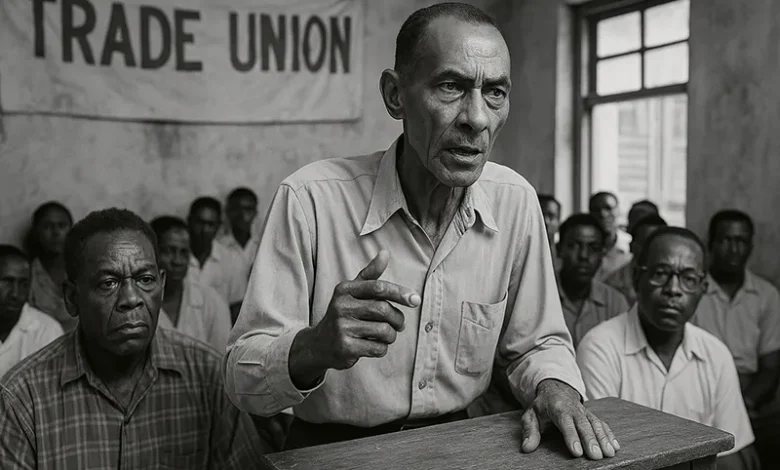
On January 11, 1945, with Ralph Nicholls and Austin Winston, he helped establish the Dominica Trade Union, the first trade union in the island’s history. The organisation spread with remarkable speed. Within six months it had 26 branches across Dominica.
The union was not only a debating society. Under Loblack’s leadership it pushed changes in working hours for labourers and domestic workers and organised port workers. The Dominica Division of Culture records that the DTU also acquired its own property in Roseau, with the union hall becoming an important meeting place for public and political discussion.
The union’s work among tenants on estates was particularly significant. Small tenants could be vulnerable to removal from land they worked but did not own. The campaign for stronger protection contributed to the Agricultural Small Tenancies Act of 1953, giving tenants legal safeguards.
For a generation of working Dominicans, that kind of organising made politics practical. Rights were no longer an abstract argument about colonial government; they could mean more predictable hours, a stronger position at work, protection on the land and a place where ordinary people could assemble and speak.
Taking Dominica’s case abroad
Loblack’s activism did not remain confined to the island. In 1949 he represented Dominica in Britain at an international free trade union conference. The Division of Culture says he used the opportunity to put Dominica’s problems before the Colonial Office.
That matters when considering the scale of his ambitions. He was not trained as a lawyer, economist or career politician. He was a mason and public works employee who had become convinced that the conditions around him were not fixed facts of life.
Dominican historian Dr Lennox Honychurch has written of Loblack as a passionate and determined figure who commanded influence among workers. His importance came not from polished social standing but from organisation: travelling, recruiting, speaking, pressing demands and turning discontent into institutions.
From trade unionism to party politics
By the 1950s, Dominica had universal adult suffrage, greatly widening the electorate beyond the old property-based restrictions. But votes alone did not create a political movement. People still had to be organised around programmes, candidates and a sense that government could represent those outside the traditional elite.
In May 1955, Loblack and writer and political activist Phyllis Shand Allfrey founded the Dominica Labour Party, the island’s first organised political party. It grew from the same social world in which the trade union had taken root: workers, small farmers and people seeking a larger voice in public affairs.
The party would go on to become one of the defining institutions of Dominican political history, although Loblack’s own relationship with it did not last. Political movements change, alliances break and the people who found institutions do not always remain inside them.
Loblack later helped found the Dominica Freedom Party in 1968 alongside figures who included Edward Scobie, Anthony Moise and Mary Eugenia Charles. That second founding role is an important reminder that his legacy cannot be reduced to the later fortunes of any single party. His larger project was political participation and the organisation of people who had previously possessed little institutional power.
The man behind the public figure
Public history can flatten people into titles — “trade union pioneer”, “political activist”, “party founder”. Loblack also had a family life that ran alongside decades of public struggle.
In 1950 he married May Maxime. They had eleven children, five boys and six girls. By then he was already a nationally known labour leader, yet he continued in government service until 1962.
Recognition came during his lifetime. On November 3, 1967, he received a Meritorious Service Award for his contribution to the workers’ movement. The University of the West Indies honoured his work as a trade union pioneer and political activist, and Dominican educational material also records him as a recipient of an award from the Bustamante Institute of Public and International Affairs.
When he died on June 3, 1995, Dominica accorded him a state funeral on June 10.
The following year, on Labour Day, May 1, the eastern bridge leading into Roseau was named the E.C. Loblack Bridge. The symbolism was unusually fitting. A man who had once worked on the island’s roads, bridges and retaining walls now had one of the capital’s gateways named after him.
His name did not remain frozen on a plaque. The bridge continued to be part of Roseau’s daily movement and public memory. In 2017 a portrait of the trade union pioneer was installed over the bridge. After Hurricane Maria damaged the structure later that year, the bridge itself required major rehabilitation, tying Loblack’s name once again to the continuing work of building and rebuilding Dominica.
Why August 29 still matters
A 128th birthday is not a conventional anniversary. There is no living celebrant and no round-number centenary. But August 29 offers a useful reason to remember how much of modern Dominican public life was built by people who started with very little formal power.
Loblack’s story begins in Grand Bay with a boy who had to work at 13. It passes through the Public Works Department, the labour struggles of the 1930s, the founding of the Dominica Trade Union in 1945, the movement for tenant protection, the creation of organised party politics in 1955 and another political founding in 1968.
He lived long enough to see Dominica become independent in 1978 and to see institutions that working people had once struggled to create become ordinary parts of national life.
That may be the most interesting measure of his achievement. The victories of labour organisers eventually become so familiar that later generations can forget they were victories at all. A working day with limits, legal protection, union representation, universal political participation and parties competing for the votes of ordinary citizens can begin to look inevitable.
They were not.
On August 29, Dominica can remember Emmanuel Christopher Loblack not simply because he would have been 128, but because so many of the arguments he helped bring into public life were about a basic Dominican question: who gets a voice in the country, and what can organised citizens change when they decide the old conditions are no longer good enough?
70