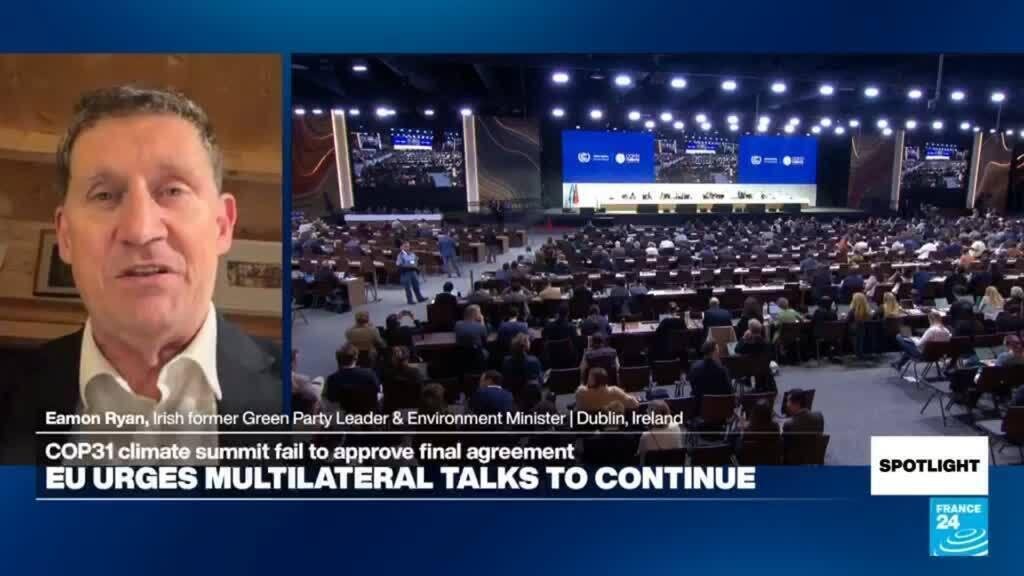
The COP31 climate summit in Antalya, Turkey, collapsed without an agreement after the European Union and up to 100 countries refused to accept a final text that abandoned earlier commitments to transition away from fossil fuels. The breakdown leaves the global climate process without a common outcome at a time when small island states, including the Commonwealth of Dominica, have repeatedly warned that they face the most severe consequences of a warming planet.
Former Irish Environment Minister Eamon Ryan, speaking to France 24 presenter François Picard after the talks ended, said the outcome had failed on political grounds rather than scientific ones. «Political science trumps climate science still», Ryan said, adding that he believed the deal on the table was poor. «This deal was a bad deal and better no deal than a bad deal», he said, arguing that a weak agreement would have done more harm than no agreement at all.
The central dispute was over the language on fossil fuels. Earlier climate commitments had called for countries to transition away from coal, oil and gas, and the final draft in Antalya removed or weakened that wording. The European Union and a large bloc of other nations judged that retreat unacceptable and refused to sign, which prevented the conference from adopting the text as a consensus outcome.
For Caribbean governments, the stalemate carries particular weight. Small island developing states have long argued that they contribute little to global emissions yet bear heavy costs from rising seas, stronger hurricanes, flooding and drought. Dominica, which has been affected by major storms in recent years and depends on climate-sensitive sectors such as agriculture, tourism and fisheries, has consistently called for ambitious emissions cuts and adequate finance for adaptation and recovery.
The collapse also raises questions about how the next stage of international climate negotiations will proceed. Without an agreed text on fossil fuels, delegations will have to decide whether to rebuild consensus on earlier commitments or to pursue smaller coalitions of countries willing to move faster. Analysts following the talks have pointed to the difficulty of reaching unanimous decisions among nearly two hundred parties with very different economic interests.
Ryan's remarks reflect a view held by many climate advocates that a weak deal can slow momentum rather than advance it, because it may be cited as justification for lower ambition later. Supporters of the EU position argued that holding firm on the fossil fuel language was necessary to keep the goals of the Paris Agreement credible. Others at the summit urged negotiators to salvage progress on areas where agreement had been reached, including adaptation finance and the protection of vulnerable nations.
For residents of Dominica, the outcome will be followed closely by officials responsible for disaster preparedness and environmental planning. The island's national interest in climate action is practical as well as diplomatic: each hurricane season tests infrastructure, homes and livelihoods, and the costs of recovery are borne largely by a small economy. Dominica's representatives have typically pressed for funding that goes directly to resilience, including roads, housing, water systems and early warning capacity.
7