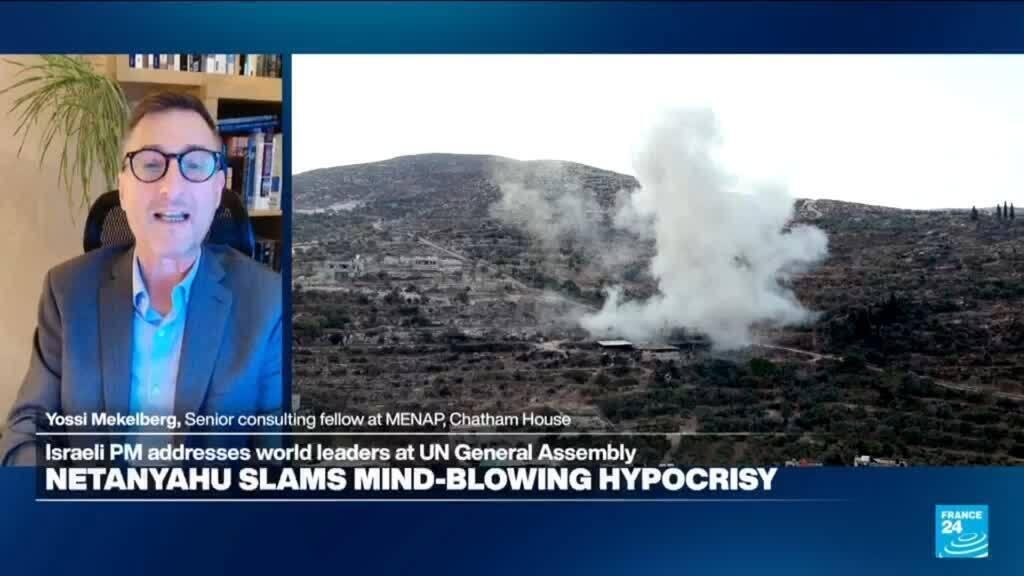
A senior fellow at the international affairs think tank Chatham House has warned that the absence of a diplomatic route between Israelis and Palestinians risks locking both societies into a state of perpetual war. Yossi Mekelberg, Senior Consulting Fellow of the Middle East and North Africa Programme, argued that military operations, incursions and settlement expansion cannot serve as a sustainable political objective for Israel.
Speaking on the question of whether Israel can continue to define its future primarily through security and territorial control, Mekelberg challenged the notion that force alone can deliver lasting stability. He identified a potential transition beyond the Netanyahu era as an opportunity to reconsider the relationship between Israeli and Palestinian societies, suggesting that a change in leadership could open space for a renewed political approach.
His central argument is that the continuation of war without a clearly defined political endgame carries serious long-term consequences. Without a diplomatic horizon, he cautioned, the region faces the prospect of unending conflict rather than a negotiated settlement. The warning comes amid sustained international concern over the direction of Israeli policy and the absence of meaningful negotiations between the two sides.
Mekelberg's intervention places the debate squarely on the strategic costs of relying on military means alone. He questioned whether security and territorial control can remain the primary lens through which Israel shapes its national future, arguing that such an approach offers no pathway to a durable political outcome. In his assessment, the current trajectory risks normalising a cycle of violence that neither society can escape.
The Chatham House fellow also pointed to the wider implications of a leadership transition in Israel. A change at the top, he suggested, could provide a moment to reboot relations between Israelis and Palestinians, moving beyond the entrenched positions that have defined recent years. That opportunity, however, would require a willingness to re-engage with the political questions that military operations cannot resolve.
For Caribbean observers, the debate carries familiar echoes. Small island states in the region have long argued that security without development and dialogue without follow-through cannot deliver lasting peace. The Commonwealth of Dominica, like its OECS and CARICOM partners, has consistently supported negotiated settlements and respect for international law in conflicts far from its shores, on the principle that the rules-based order protects small states as much as large ones.
Mekelberg's analysis does not offer a detailed roadmap, but it frames the choice clearly. Either the parties find a political route back to the negotiating table, or the conflict continues without end. His warning that perpetual war is the alternative to diplomacy is a reminder that military victories, however defined, cannot substitute for a political settlement that addresses the aspirations of both peoples.
The comments add to a growing body of expert opinion that questions the sustainability of a purely security-driven approach. As the region awaits any sign of a shift in direction, Mekelberg's argument stands as a caution: without a diplomatic route, the guns may fall silent only to be fired again.
2